You’ll recognise the hallmarks. Banners with renders of utopian urban dwellings – a marriage of contemporary lines, streamlined surfaces, open-plan living spaces and floor-to-ceiling glass, alongside manicured green spaces and lifestyle imagery of young professionals and families. Not necessarily the vision of a quarter-acre block with a white picket fence but in urban centres the Australian dream of home ownership is being recast in the form of white-cube, new-build apartments.
In the US, “5-over-1” buildings are fast becoming ubiquitous, while in Europe, where apartments have always been smaller, there’s a rise in shared-space models with communal kitchens and amenities. Shanaka Herath, a senior lecturer at the school of built environment at the University of Technology Sydney, says: “We know that land costs have been rising, construction costs have been rising, so what the builders do is that they build smaller and more affordable units.”
In Australia, he says, “The combination of high demand and construction costs with limited supply encourages compact apartments in the cities as a model.”
But how does one make the space between these generic walls feel personal as well as practical? An off-the-plan apartment owner and artist, Ben Mazey, says even when the foundations are basic, like a supermarket sponge cake, “You can do the icing yourself, and you can make it yours.”
Finesse the finishes
Having a bath was on Mazey’s wishlist when he bought a two-bedroom apartment in Melbourne. With the help of an interior designer friend, he made changes early on. In the kitchen, he had custom stainless-steel cabinetry and handles installed to replace the original timber-veneer fronts, and added a stone island bench and stone tiles underfoot, instead of timber flooring. In the bathroom, he bypassed the half walls of taupe tile and chose floor-to-ceiling white “norm-core” square tiles, and had his desired bath accommodated into the layout.
To create his “Carrie Bradshaw moment” he repainted his walk-in-wardrobe a vibrant shade of pistachio, separating it from the main bedroom. “Paint’s straightforward, not that expensive and can absolutely transform a space,” he says.
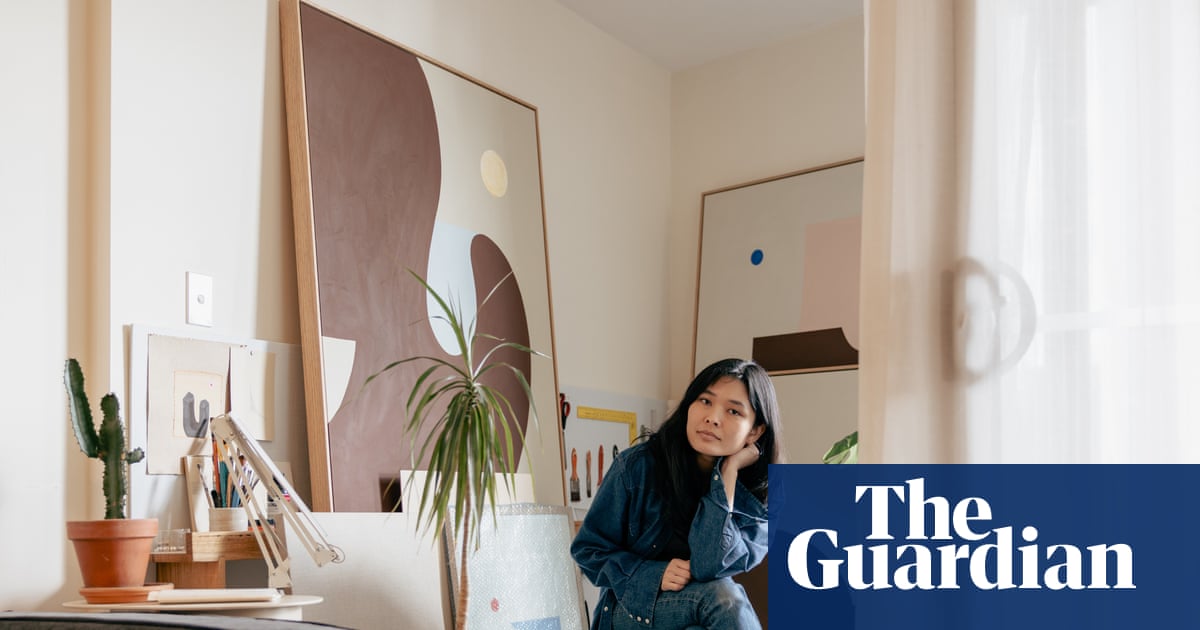
Cat Yenn, a designer and artist, has been in her studio apartment in Sydney for two years, sharing the space with her partner and her rescue chihuahua, Wonton. Visual division is crucial to avoiding chaos and clutter.
“I took inspiration from small Italian apartments and went curtain crazy,” she says. “I found gingham fabric and ended up making curtains to cover my fridge nook and exposed shelves.”
This introduced “handmade touches throughout the house”, adding “softness and warmth”.
When the designer and stylist Jono Fleming moved into his new-build two-bedroom Sydney apartment nearly a decade ago, it came with quality architectural elements including generous architraves, satin cornices, brick feature walls and steel doors.“The details were just really beautiful,” Fleming says, “and really uncommon in an off-the-plan apartment”.
These features have informed some of his most striking decorating choices. The brick wall in the living area has become a stage for an ever-changing art wall, with trailing ivy and an open shelf for treasured magazines and books.
While adding a brick or tiled feature wall may be unrealistic for many apartment dwellers, using paint or wallpaper can create an interesting backdrop. Similarly, installing new doors can be costly but changing handles, architraves or cornices is more budget-friendly. Even these subtle tweaks can make an outsized change to your overall perception of a space.
Pick flexible furniture
Fleming’s favourite furniture trick in an open-plan living area is to place two of the same sideboards together, because it’s cheaper than bespoke joinery, “and looks really good”.
“Give yourself styling and storage space. It makes your room feel more grounded, intentional and elongated.”
Open shelves grouped together across a wall create opportunities to display potted plants, favourite books, souvenirs, artworks and objects. In small spaces, furniture needs to be multi-functional – stools and ottomans are great for when guests visit, while extendable drop-leaf dining tables work well for entertainers.
As to finding furniture, Mazey suggests you “get on Facebook Marketplace”.
“I’m forever on there and there’s beautiful oak furniture for $150. I have some lovely things in my place but I feel like everything in my house either costs less than 50 bucks or more than two grand.”
Tell a story with decoration
Personal displays are the best way to bring character into an otherwise sterile space. Fleming’s home, which he shares with his husband, the interior architect Ryan McGregor, has knick-knacks on their sideboards and side tables: ceramics and sculptures grouped by tone, candles in glassware for colour, a table lamp for height.
“Everything has a story from somewhere we’ve travelled, or it’s from an artist that we like or from a favourite shop,” McGregor says. “Ask yourself what is the story of your home? What do you love and what is it that you keep going back to? I think art and objects are staples.”
Yenn says art displays “works best when you … connect them visually with harmonious colours”. A self-confessed “collector – not hoarder! – of chairs and trinkets”, she lives in a petite home out of financial necessity, and says its scale forces her to be strict about what she buys and what she keeps.
Her apartment also serves as her art studio. “It’s my favourite thing to get out of bed and see paintings in progress,” she says.
For Mazey, “objects that you genuinely respond to” aren’t an exercise in excess.
“It has absolutely nothing to do with your budget because you can do it on the smell of an oily rag.”